

Sponsored UK visit visa from Pakistan: what your sponsor must send, and what to leave out
If a relative in the UK is paying for your trip or hosting you, their evidence becomes part of your file. The Home Office asks for five specific things from a sponsor, and two of the documents Pakistani applicants are most often told to include are on its list of what not to send. Here is the correct set, with a sample sponsorship letter.
Most UK visit visa applications from Pakistan involve a sponsor somewhere: a brother in Manchester paying for the flight, a daughter in Birmingham whose spare room you will stay in, a son covering everything for parents who have never travelled. The moment someone else is providing your travel, your maintenance or your accommodation, their circumstances become part of your application, and their paperwork is judged as carefully as yours.
This is also the part of the file where the advice circulating in Pakistan is most often wrong. Two documents that applicants are routinely told to collect — the sponsor's utility bill and their council tax statement — appear on the Home Office's own list of documents you should not use as evidence. Sending them does not strengthen anything, and it signals a file assembled from forum posts.
The five things a sponsor must evidence
The Home Office is specific. If someone else is providing your travel, maintenance or accommodation, you should provide evidence showing:
- What support is being provided, and whether it extends to any dependent family travelling with you
- How that support is being provided
- That the sponsor has enough funds to adequately support themselves and their own dependants
- The relationship between you and the sponsor — family member, employer, and so on
- That the sponsor is legally in the UK, where that applies — for example a British passport or a residence document
Read point 3 again, because it is the one applicants underestimate. The test is not whether your sponsor can afford your trip. It is whether they can afford your trip on top of their own household. A cousin earning £2,200 a month with three children and a mortgage may be entirely sincere and still not read as able to support two extra visitors for a month.
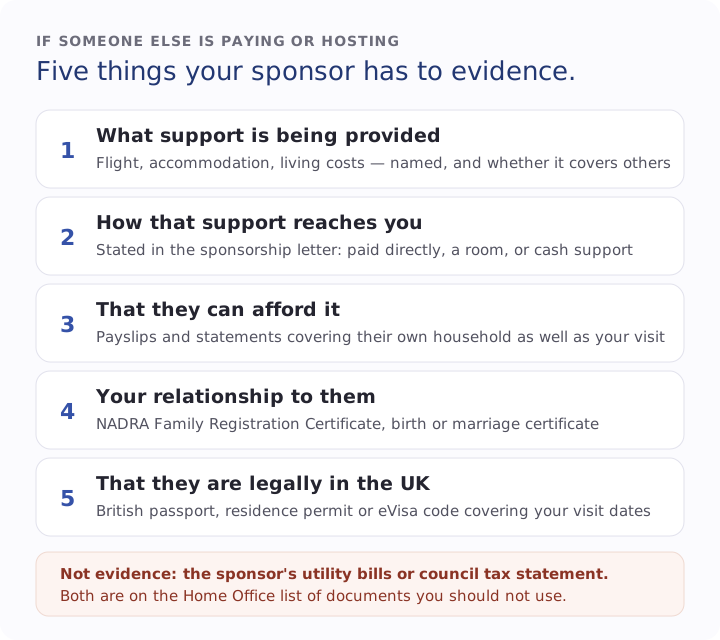
The documents that prove each one
What support, and how. A signed sponsorship letter from your sponsor. This is the document that does most of the work, and there is a sample below. It should name exactly what is covered — flight, accommodation, living costs, or some combination — and say whether it covers anyone travelling with you.
That they can afford it. Their recent bank statements, and evidence of their income: payslips, or an employer's letter, or their self-assessment return if they are self-employed. The same origin test applies to their account as to yours. A sponsor's statement showing a salary arriving monthly and a balance that has been there for months is worth more than a larger balance that appeared last week.
The relationship. Whatever proves it: a Family Registration Certificate from NADRA showing you on the same family record, birth certificates, your marriage certificate, or a chain of documents if the link runs through a parent. If your name on one document differs from another — a maiden name, a father's name recorded differently — deal with it explicitly rather than hoping nobody notices.
Their status in the UK. The photo page of their British passport, or their biometric residence permit, or their share code and status confirmation if they hold eVisa status. A relative on a time-limited visa should show that their own permission covers the period of your visit.
Accommodation, where they are hosting you. Their letter confirming the address, that you will stay there and for how long. If they rent, their tenancy agreement establishes they can offer the room. If they own, the mortgage statement or title does.
What to leave out
The official guidance lists documents that are less useful as evidence in visit applications. From the sponsorship side of the file, that means leaving out:
- The sponsor's utility bills
- The sponsor's council tax bills
- Hotel bookings, and flight bookings unless you are transiting
- Travel insurance
- Credit card statements
- Bank statements or letters issued more than a year before the date of application
The utility bill and the council tax statement are worth dwelling on, because an enormous amount of Pakistani visa advice recommends them as proof that the sponsor really lives at the address. The Home Office has decided they do not add anything. If you need to establish the address, the tenancy agreement or mortgage statement does it and is not on the list.
One more thing worth knowing if several of you are applying together: you do not need to provide multiple copies of the same documents when a family or group applies at the same time. One set of your sponsor's evidence covers the group.
A sample sponsorship letter
Adapt this rather than copying it. Every figure in it must match a document in the file.
Sponsorship letter
14 October 2026
To the Entry Clearance Officer, UK Visas and Immigration
Re: Standard Visitor visa application — Mr Abdul Rehman Khan, Pakistani passport AB1234567
I am writing to confirm that I am sponsoring and hosting my father, Mr Abdul Rehman Khan, for his visit to the United Kingdom from 12 November to 6 December 2026.
I am Bilal Ahmed Khan, a British citizen (passport 123456789), and I have lived in the United Kingdom since 2011. I work as a registered nurse at Leeds Teaching Hospitals NHS Trust, where I have been employed since August 2016, with a gross annual salary of £41,600. My employer's letter and my last three months of payslips are enclosed, together with six months of statements for my Lloyds account, into which my salary is paid.
What I am providing. I will pay for my father's return flight, and he will stay with me at the address below for the whole of his visit at no cost to him. I will meet his living costs while he is in the UK. He is travelling alone and I am not sponsoring anyone else on this application.
My household. I live with my wife and our two children at 42 Hartley Avenue, Leeds LS6 2HZ, a three-bedroom house we own with a mortgage. My father will have his own room. After my mortgage and household costs I have sufficient income to support my family and to cover my father's visit, as my statements show. The mortgage statement for the property is enclosed.
Our relationship. Mr Abdul Rehman Khan is my father. Our Family Registration Certificate from NADRA and my birth certificate are enclosed.
His visit. He is coming to spend time with his grandchildren and to attend my daughter's school prize-giving on 28 November. He will return to Pakistan on 6 December, where my mother, his home in Peshawar and his pension remain.
I confirm the above is true and I am happy to be contacted on 07700 900123 or bilal.khan@example.co.uk if anything further is needed.
Yours faithfully,
Bilal Ahmed Khan
Enclosed with that letter: his passport photo page, employer's letter, three payslips, six months of bank statements, mortgage statement, the NADRA Family Registration Certificate and his birth certificate. Not his gas bill.
Where sponsored files go wrong
- The sponsor's generosity is not documented. "My brother will take care of everything" in a cover letter, with nothing from the brother, is worth nothing. Support that is not evidenced is not support.
- The support is not costed. A letter promising to cover the visit, with no figure anywhere in the file for what the visit costs, leaves the caseworker unable to tell whether the sponsor can actually cover it.
- The sponsor's own position is thin. Sponsors are sometimes reluctant to share statements with family. If they will not, they cannot sponsor, and you are better off funding the trip yourself and saying so.
- The applicant's own ties disappear. A sponsored file still has to show that you will leave at the end of the visit. Your job, your family in Pakistan and your own circumstances matter just as much in a sponsored application as an unsponsored one. Being paid for does not remove the need to show you are coming back.
- The two stories disagree. The sponsor's letter says he is covering the flight; your cover letter says you are paying for it yourself. Caseworkers read both.
- The sponsor is not legally settled. A relative whose own permission to be in the UK expires during your visit is a problem you should raise and explain, not leave to be discovered.
If children are travelling
If an applicant is under 18, the file needs a legal document showing the relationship to at least one parent or guardian — a birth certificate or adoption papers — and a copy of the photo page of that parent's passport if they are not also applying.
Where a child is not travelling with their parent or guardian, you should provide a signed letter from the parent or guardian confirming their consent, who is travelling with the child (with that adult's passport number), who will look after the child in the UK, and how the child will travel. The guidance is explicit that an application may be refused without it.
Before you submit
- Does the sponsorship letter say exactly what is covered, and does your cover letter say the same thing?
- Is there a figure somewhere in the file for what the trip will cost?
- Do the sponsor's statements show income arriving, not just a balance?
- Is the relationship proved by a document, not asserted?
- Is the sponsor's UK status evidenced?
- Have you left out the utility bills, the council tax statement, the insurance and the bookings?
Submitting all of this does not guarantee a visa — the Home Office says so itself. What it does is answer the sponsor questions before they are asked, so the decision turns on your circumstances rather than on a gap in someone else's paperwork.
How Niklo checks this
Niklo reads your documents and your sponsor's, puts the answers into the official form, and flags the places a sponsored file usually fails: support described in one document and contradicted in another, a sponsor whose income does not cover their own household alongside your visit, a relationship asserted but not evidenced, documents from the do-not-send list. The automated review runs against the Home Office's published guidance and a case reviewer goes through the whole file before you see it.
You file the application yourself. Niklo prepares and checks it; the decision rests with the embassy, and nothing here is legal or immigration advice.
Read next
- Bank statement for a UK visit visa from Pakistan: how much to show
- UK visit visa requirements from Pakistan: the complete checklist
- Cover letter for a UK visit visa from Pakistan, with a sample
Sources
- GOV.UK, Visiting the UK: guide to supporting documents, updated 25 February 2026 — sections 3, 4 and 13
- Home Office, Appendix V: Visitor, Immigration Rules
Would you rather we prepared it?
Niklo fills the form from your answers, AI and a case reviewer check every field, and you get the finished application to print and file yourself.