

UK visit visa requirements from Pakistan: the complete checklist
Everything a Pakistani applicant needs for a UK Standard Visitor visa, taken from the Home Office's own guidance: the four things you must prove, the documents that prove them, what to leave out, and how the process runs from Islamabad, Karachi and Lahore.
A UK Standard Visitor visa lets you spend up to six months in the UK for tourism, to see family, to attend meetings or a conference, or for a short course of study. The Home Office publishes its own guide to the documents it wants to see. Most Pakistani applicants never read it, and most refusal letters from Islamabad quote it. This guide takes that official list and explains what each item means for an applicant with a Pakistani passport, a CNIC and a bank account in rupees.
The four things every applicant must prove
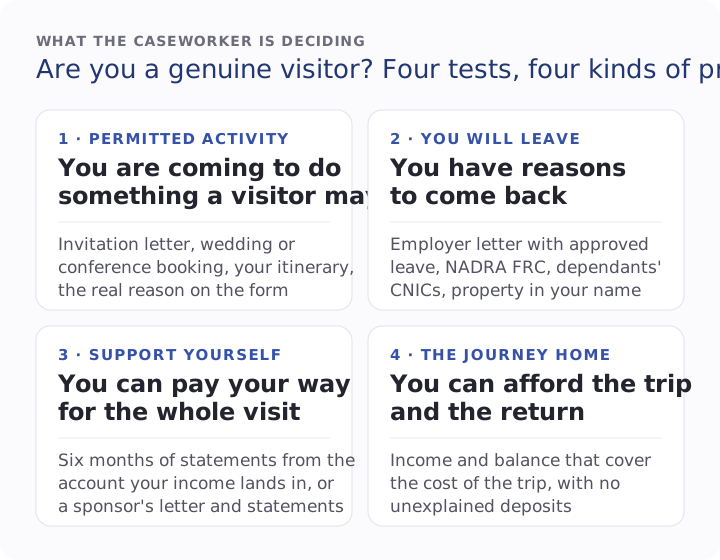
The caseworker is not ticking boxes. They are deciding whether you are a genuine visitor, and the Home Office says that means showing four things:
- You are coming to do something a visitor is allowed to do.
- You will leave the UK at the end of your visit.
- You can support yourself, and anyone travelling with you, for the whole trip.
- You can pay for your journey home and everything else the visit will cost.
Every document you attach should help prove one of those four. A document that proves none of them adds nothing, and the Home Office says so plainly in its list of things not to send, covered below.
Submitting every document on this page does not guarantee a visa. The Home Office says this itself. What a complete, consistent file does is get your application decided on its merits rather than on a gap.
Your passport
You must have a valid passport. It should be valid for the whole of your intended stay, and it needs at least one blank page for the visa sticker. Old passports matter too: the Home Office asks for copies of previous passports that show travel to other countries, because a record of trips you returned from is evidence that you will return from this one. If your previous passport is with you, photograph every page that carries a visa or a stamp. Umrah trips, UAE visits and Malaysia holidays all count.
Proof of your circumstances in Pakistan
This is where the second test, that you will leave, is decided. The Home Office asks for information about your circumstances in your home country and the activity you will do in the UK. In practice that means proving what you have to come back to.
If you are employed. A letter from your employer on company letterhead, giving your role, your salary, your start date and the leave they have approved for this trip. The letter should be signed, with the signatory's name and a phone number the Home Office can call. Verification calls to Pakistani employers are routine. Add your last three to six salary slips.
If you run a business or are self-employed. Your business registration or your NTN certificate, recent tax returns, and recent invoices or contracts that show the business is trading now. Business bank statements in the company's name are strong evidence, personal statements alone are not.
If you are a student. A letter from your school, college or university on headed paper confirming your enrolment and the leave of absence covering your travel dates. A student rarely funds their own trip, so read the section on sponsors below.
If you are a homemaker or retired. Apply with the documents of the person who supports you, a clear statement of who is funding the trip, and the family evidence below. Pension documents count for a retired applicant.
Family ties. Your spouse's and children's CNICs or B-forms, and a Family Registration Certificate from NADRA, especially when your family is staying behind. Property documents in your name, such as a registry or fard, help. Ties are judged on the whole picture, not on any one paper.
Money: what the bank statement has to show
There is no minimum balance for a Standard Visitor visa. The Home Office asks for financial documents that clearly show you have access to the funds, and it specifically names bank statements that show the origin of the money, and proof of earnings such as an employer's letter confirming your start date, salary and role.
That word, origin, is the one that refuses Pakistani applications. The caseworker reads six months of statements to see where the money came from. A salary arriving on the same date every month is an origin. A single transfer of Rs 2,000,000 from a brother three weeks before the application is not, and the statement will be read as borrowed money.
- Provide the last six months of statements for the account your salary or business income is paid into, stamped by the bank or downloaded from online banking.
- The salary credits on the statement must match the figure on your employment letter.
- Keep the money where it already is. Do not consolidate relatives' funds into your account for the application.
- If someone else is paying, say so and show their money, not yours. See the next section.
- Statements or bank letters issued more than a year before the application are on the Home Office's list of documents not to use.
A steady balance of a few hundred thousand rupees over six months is stronger evidence than a large sum that arrived last month.
If someone else is paying
If a relative or friend is covering your travel, your accommodation or your living costs, the Home Office wants five things from you:
- What support they are giving, and whether it also covers anyone travelling with you.
- How it is being given, for example a place to stay, or money for the trip.
- That they have enough to support you as well as themselves and their own dependants, which means their bank statements or payslips.
- Your relationship with them, for example a birth certificate or FRC for a parent or sibling, or a nikah nama for a spouse.
- That they are legally in the UK if they live there, shown by a copy of their British passport or their residence permit.
Put all of this in one signed sponsorship or invitation letter from them, with their full name, address and phone number, and attach the documents that back it up. Their utility bills and council tax bills are on the list of documents the Home Office says not to send.
Visiting family or attending a wedding
Give the real reason for the visit on the form. If you are attending a wedding, say so. An invitation letter from your host should give their address, how long you will stay with them, and what they are providing. If you are married and your nikah nama is in Urdu, it needs a certified translation, covered below.
Business meetings and conferences
If you are visiting for work-related activity that is allowed on a visitor visa, such as meetings, negotiations or attending a conference, the Home Office asks for documents showing what you will be doing in the UK, why, and whether any costs are being paid by someone else, including letters from the organisation inviting you and the one sending you. For a conference, attach the organiser's invitation. If you are visiting your own company's UK office, a letter from your employer should confirm the visit and, if you will work with clients, that this is not the main purpose of the trip. You cannot take paid work or provide services to a UK client on a Standard Visitor visa.
Children under 18
A child needs a legal document showing the relationship to at least one parent, such as a birth certificate, and a copy of the photo page of a parent's passport including their signature, if that parent is not also applying. If the child's family name differs from the parent's, add evidence of the relationship, such as a birth certificate or a marriage or divorce certificate for the parent.
If the child is travelling without a parent, the Home Office says the application may be refused without a signed letter from the parent giving consent for the trip and stating who the child is travelling with, including that adult's passport number, who will look after the child in the UK, and how the child will travel. If the parent has no passport, another official document with their signature will do.
Documents in Urdu
Any document that is not in English or Welsh must come with a full translation that the Home Office can independently verify. The translation must carry the translator's confirmation that it is accurate, the date, the translator's full name and signature, and their contact details. Nikah namas, property papers, some bank letters and death certificates are the documents Pakistani applicants most often send untranslated, and an untranslated document is treated as though it was never sent.
What not to send
The Home Office lists documents that are less useful as evidence in a visit application. Pakistani applicants pad their files with several of these, and a thick folder of them does not help:
- Bank statements or bank letters more than a year old
- Credit card statements
- A driving licence
- Educational certificates not required for your visa
- Evidence of car ownership
- Personal photographs
- Notarial certificates
- Business cards
- Hotel bookings, and flight bookings unless you are transiting
- Photocopies of bank cards
- Certificates for leisure activities, such as sports trophies
- Travel insurance
- A sponsor's utility bills or council tax bills
That means you should not buy a ticket before the decision. Say on the form when you plan to travel and where you will stay. A booking is not evidence, and a non-refundable ticket is money lost if the answer is no.
How the process works from Pakistan
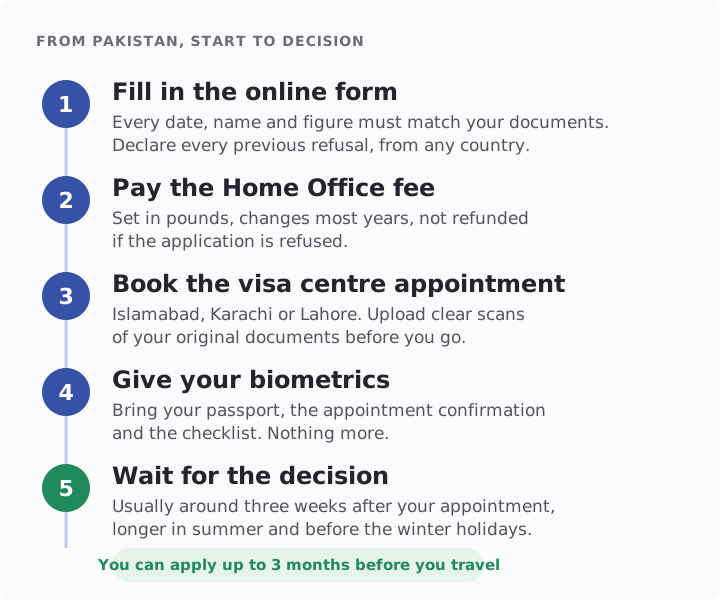
- Fill in the online application. Every date, employer name, salary figure and previous trip must match your documents, because the caseworker checks the documents against the form, not the other way round. Declare every previous refusal from any country, however old. An undeclared refusal is treated as deception.
- Pay the Home Office fee online. The fee is set in pounds and changes most years, so check the current figure when you apply. It is not refunded if the application is refused.
- Book your appointment. Applications from Pakistan are handled through the visa application centres in Islamabad, Karachi and Lahore. Upload clear scans of your documents before the appointment. The Home Office asks for digital images of original documents, not copies.
- Give your biometrics. Bring your passport, the printed appointment confirmation and the checklist the online system generated. Bring only what the checklist asks for.
- Wait for the decision. A standard decision from Pakistan usually takes around three weeks after your appointment, longer in summer and before Christmas. You can apply up to three months before your travel date, so apply early and never before every document is in hand.
The checklist
- Passport, valid for the whole stay, with a blank page, plus photographs of old passports with stamps and visas
- CNIC, both sides
- Employment letter on letterhead with role, salary, start date, approved leave and a contact number, plus salary slips; or business registration, NTN, tax returns and invoices; or an enrolment letter
- Six months of bank statements for the account your income is paid into
- Family Registration Certificate from NADRA and your dependants' CNICs or B-forms
- Property documents in your name, if you have them
- Previous UK visa vignettes, and any visa from the USA, Canada, Australia, New Zealand, Switzerland or the European Economic Area
- Sponsorship or invitation letter with the sponsor's evidence, if someone else is paying or hosting you
- Certified translations for anything in Urdu
- Nothing from the list of documents not to send
Before you submit, put the form and the documents side by side and ask one question of each: does anything here disagree with anything else? A file that is consistent, honest about its history and clear about who is paying is a file that gets a fair decision. That is the whole of what the requirements ask for.
Would you rather we prepared it?
Niklo fills the form from your answers, AI and a case reviewer check every field, and you get the finished application to print and file yourself.