

Bank statement for a UK visit visa from Pakistan: how much to show and what it must prove
The Home Office has never published a minimum bank balance for a visit visa, and the figures you find online are guesses. What the rules actually ask for is evidence that you can access the money and that it is yours. Here is what that means for a Pakistani account, how to work out the figure for your own trip, and the deposit that refuses more files than any other.
Ask what bank balance you need for a UK visit visa and you will be told £100 a day, or a million rupees, or six months of statements showing five hundred thousand. Every one of those numbers is somebody's guess. The Home Office has never published a minimum balance for a Standard Visitor visa, and no caseworker is comparing your closing balance against a threshold.
That is not good news or bad news. It means the question most Pakistani applicants ask about money is the wrong one. The rules do not ask how much you have. They ask whether you can pay for this particular trip, and whether the money in the account is actually yours.
What the rules actually say
The Home Office's guide to supporting documents asks for:
financial documents showing that you have sufficient funds available. These must clearly show that you have access to the funds, such as bank statements which detail the origin of the funds held.
Two words in that sentence decide most Pakistani files.
Access. The money has to be reachable by you, now. A balance in your father's account is not your access. A fixed deposit you cannot break for eleven months is not your access. Property worth two crore is not your access, though it is excellent evidence of something else.
Origin. The statement has to show where the money came from. This is the word that refuses applications from Pakistan, and it is why a screenshot of a healthy closing balance proves almost nothing on its own.
Note also what "sufficient" is measured against. The four things every visitor must show include supporting yourself and any dependants for the whole trip, and paying for the journey home. Sufficient means sufficient for your visit — a costed two-week trip, not an abstract number.
Working out your own figure
Since there is no published figure, build one. Add up what the trip will genuinely cost and show comfortably more than that.
| Item | How to estimate it |
|---|---|
| Return flight | Current fare on your intended dates, Islamabad, Karachi or Lahore to your UK airport |
| Accommodation | Nightly rate × nights, or zero if you are staying with family who confirm it in writing |
| Living costs | A realistic daily figure for where you are going; London is not Bradford |
| Internal travel | Rail or coach between the cities in your itinerary |
| Home Office fee and visa centre charges | Paid before the decision, so not part of the trip cost, but budget for them |
| Margin | Enough that an unexpected week does not strand you |
A file showing Rs 900,000 against a costed Rs 420,000 trip is stronger than one showing Rs 3,000,000 against nothing at all, because the first one answers the question and the second one leaves the caseworker to guess.
If you see a per-day figure quoted as an official requirement, treat the source with caution. It is a rule of thumb somebody invented, and repeating it back in your cover letter does not help you.
Which account, and how many months
Use the account your income actually arrives in. If your salary goes to a Habib Bank account and your savings sit in Meezan, send both, and say in your cover letter which is which.
On the period: the rules do not set one. What they do say is that bank statements issued more than a year before the date of application are not useful evidence. Six months is the practical standard, and the reason is origin rather than any rule. Six months is roughly the shortest run that shows a salary arriving on the same date each month, a business taking money in week after week, or a balance that has simply sat there. One month shows a balance. Six months shows a pattern, and the pattern is the evidence.
Your statements should carry, on the bank's own stationery or as an official PDF:
- Your full name exactly as it appears on your passport
- The account number and the branch
- The period covered, running up to within a few weeks of your application
- Every transaction in that period, not a summary
- The closing and, if your bank prints it, the average balance
Have them stamped and signed by the branch. Pakistani banks do this as routine, it costs very little, and it removes a question before it is asked. Send digital images of the original documents rather than photocopies.
The deposit that refuses files
This is the single commonest funds problem in Pakistani applications, and it is worth understanding precisely.
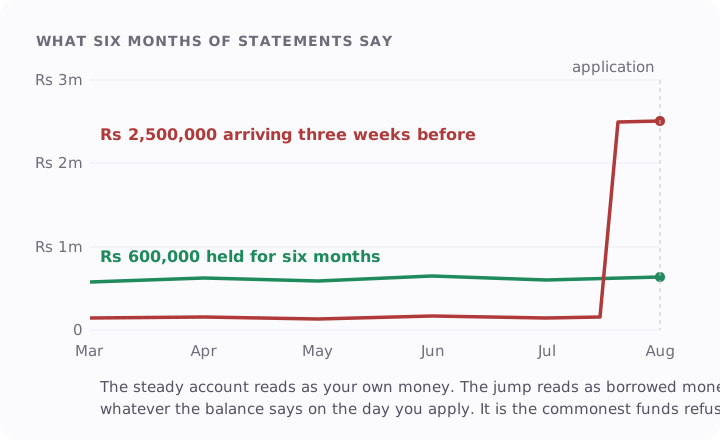
Two applicants apply on the same day. One has held about Rs 600,000 for six months, fed by a salary of Rs 95,000 arriving on the 1st. The other shows Rs 2,500,000 — but Rs 2,100,000 of it arrived in one transfer nineteen days before the application, from an account the statement does not name.
The second applicant has four times the balance and the weaker file. The caseworker is not being unreasonable. They are reading a statement that shows money appearing from nowhere shortly before it needed to be there, which is what borrowed money looks like. Funds parked for an application are a known pattern, and a large unexplained credit close to the application date invites exactly that reading.
The fix is not to hide the deposit. It is to explain it, in the cover letter, with the document that proves it:
- Sale of a property or a car — the sale deed or transfer letter, and the buyer's name matching the credit
- Inheritance — the succession certificate or distribution deed
- Gratuity, provident fund or a pension lump sum — the employer's letter
- A genuine family gift — say who gave it, their relationship to you, and attach their statement showing the money leaving their account. A gift you can document is not a problem; a gift you leave unexplained is
- Money returned from a business or a committee — the underlying record
One honest paragraph naming the source and pointing to the evidence turns the worst line in your statement into an ordinary one.
If you are self-employed or have no salary
Plenty of strong applicants have no payslip. A shopkeeper, a landlord, a freelancer billing overseas clients and a retired teacher all have origin, it just looks different.
- Business owner: business registration, NTN, the last tax return, recent invoices, and the business account alongside your personal one. Show the money moving from one to the other.
- Freelancer: contracts or invoices, and the inward remittance advices your bank issues for foreign payments. Remittances arriving steadily read as income.
- Rental income: the tenancy agreement and the matching monthly credits.
- Retired: the pension order and the pension arriving each month.
- Supported by your family: this is a sponsored application, and it is a different document set. See the sponsored visit guide below.
The Home Office also accepts proof of earnings such as a letter from your employer confirming your start date, salary, role and company contact details. Where you have one, it should agree with your statements to the rupee. A letter saying Rs 285,000 against credits of Rs 250,000 is read as a discrepancy, not a rounding.
What not to send
The official guidance lists documents that are less useful as evidence. From the money side of the file, leave out:
- Credit card statements
- Photocopies of bank cards
- Bank statements or letters issued more than a year before you apply
Also on that list, and relevant if you are building a travel budget: hotel bookings, flight bookings (unless you are transiting) and travel insurance. Do not buy a ticket to prove intent. It is not evidence, and it is money lost if the answer is no.
Before you submit
Put your form, your cover letter and your statements side by side and check four things.
- Does the salary figure on the form match the credits on the statement and the figure in the employment letter?
- Is every credit over a few hundred thousand rupees either obviously routine or explained in the cover letter?
- Does the balance comfortably cover the trip you have costed, with the cost stated somewhere in the file?
- Is the most recent statement recent — weeks old, not months?
A file that passes those four is not guaranteed a visa. The Home Office says plainly that submitting the listed documents does not guarantee success, and no honest guide will tell you otherwise. What a consistent, explained file does is get your application decided on its merits instead of on a gap.
How Niklo checks this
Niklo reads the statements you upload, pulls the figures into the official form, and flags where the money side of your file will raise a question: a credit that appears without explanation, a salary that disagrees with your employment letter, a closing balance thin against the trip you have described, a statement that has gone stale while you gathered the rest. An automated review against the Home Office's published guidance produces the list, and a case reviewer goes through the file before it reaches you.
You file the application yourself. Niklo prepares and checks it; the decision rests with the embassy, and nothing here is legal or immigration advice.
Read next
- UK visit visa requirements from Pakistan: the complete checklist
- Sponsored UK visit visa from Pakistan: what your sponsor must send
- Cover letter for a UK visit visa from Pakistan, with a sample
- Eight mistakes that get UK Standard Visitor applications refused
Sources
- GOV.UK, Visiting the UK: guide to supporting documents, updated 25 February 2026
- Home Office, Appendix V: Visitor, Immigration Rules
Would you rather we prepared it?
Niklo fills the form from your answers, AI and a case reviewer check every field, and you get the finished application to print and file yourself.