

Eight mistakes that get UK Standard Visitor applications refused
Most refusals from Pakistan are not about weak profiles. They come from files that contradict themselves, hide an old refusal, or show money that arrived last week. Here is what caseworkers actually check, and how to get each part right.
Most UK Standard Visitor refusals from Pakistan are not about weak profiles. They are about files that contradict themselves, leave a gap the caseworker fills with the worst assumption, or hide something the Home Office already knows. Each of those is avoidable. Here are the mistakes we see most often, and what to do instead.
Mistake 1: Treating the online form as a formality
The application form is the first thing the caseworker reads, and the documents are checked against it, not the other way round. Every date, employer name, salary figure and travel history entry on the form must match what your documents say.
- Enter your employer's name exactly as it appears on your employment letter and salary slips.
- State your monthly income as it shows on your bank statement, not the gross figure on your contract.
- List every previous trip in the last ten years, including Umrah and short trips to the UAE. Missing trips look like concealment.
- Give the real reason for the visit. "Tourism" when you are attending a cousin's wedding is a contradiction waiting to be found in your invitation letter.
The Home Office keeps a record of every UK application you have ever made. If the new form disagrees with an old one, the caseworker sees both.
Mistake 2: Not declaring a previous refusal
The form asks whether you have ever been refused a visa for the UK or any other country. Applicants who were refused a Schengen or US visa years ago often leave this blank, hoping it will not come up. It comes up. Visa systems share refusal data, and an undeclared refusal is treated as deception.
Declare every refusal, from any country, however old. A declared refusal with a short, honest explanation of what has changed since then is survivable. An undeclared one is grounds for refusal on its own and can lead to a ten-year ban from the UK.
Mistake 3: A bank statement that tells the wrong story
There is no minimum balance for a Standard Visitor visa. What the caseworker looks for is whether the money is yours, whether it has been there for a while, and whether it matches your declared income.
- Provide six months of statements from the account your salary is paid into.
- Do not deposit a large sum shortly before applying. A jump from Rs 150,000 to Rs 2,500,000 three weeks before the application is the single most common reason for a "not satisfied about your financial circumstances" refusal.
- If a relative is funding the trip, say so on the form, attach a sponsorship letter, and include their statements instead of moving their money into your account.
- Make sure the salary credits on the statement match the figure on your employment letter, month by month.
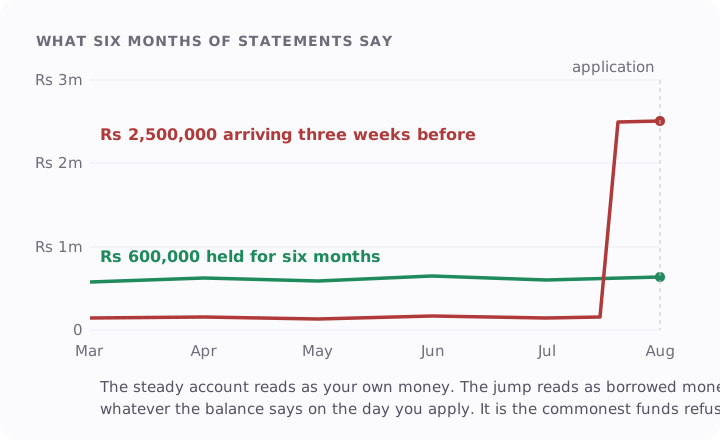
A steady account holding Rs 600,000 for six months is far stronger than one holding Rs 3,000,000 that arrived last month.
Mistake 4: Weak or missing proof of ties to Pakistan
The legal test is whether you are a genuine visitor who will leave the UK at the end of your visit. Caseworkers decide this from your ties: what you have to come back to. Most refusal letters from Islamabad quote this paragraph.
Evidence at least two of these properly:
- Employment: a letter on company letterhead confirming your role, salary, date of joining and the approved leave dates for this trip, signed by someone whose name and number are on the letter.
- Business: registration documents, NTN certificate, recent tax returns and business bank statements.
- Property: title documents or a registered lease in your name.
- Family: your spouse's and children's CNICs or B-forms, and a Family Registration Certificate from NADRA if your dependants are staying behind.
A student should include an enrolment letter and a sponsorship letter from the parent paying for the trip. A homemaker should apply with the spouse's documents attached and a clear explanation of who is funding the visit.
Mistake 5: An itinerary that does not add up
Caseworkers add up the cost of your trip and compare it with your funds and income. A three-week stay in London on a monthly salary of Rs 90,000 with no sponsor does not add up, and no amount of paperwork changes that arithmetic.
- Keep the trip to what you can plausibly afford and explain who pays for what.
- Book refundable accommodation or use a relative's invitation letter with proof of their address and immigration status.
- Do not buy a non-refundable ticket before the decision. A flight reservation is enough.
- Make sure the leave dates on your employment letter cover the whole trip.
Mistake 6: Documents in Urdu without a certified translation
Any document that is not in English must come with a certified translation that includes the translator's details, the date, and a confirmation that it is an accurate translation of the original. Nikah namas, property documents and some bank letters are the usual offenders. An untranslated document is treated as if it was not submitted.
Mistake 7: Letting an agent write your file
Some agents in Pakistan submit applications with fabricated employment letters, doctored statements or invented sponsors. If the Home Office finds a false document, the application is refused for deception and you are banned from the UK for ten years, even if the rest of your file was genuine. Verification calls to employers and banks are routine.
Prepare your own file, or use a service that checks your documents rather than invents them. Read every page of the application before it is submitted in your name.
Mistake 8: Turning up at the visa centre unprepared
After you submit the form and pay the fee online, you book an appointment at a visa application centre in Islamabad, Karachi or Lahore to give your fingerprints and photograph. Applicants regularly lose their slot, or their supporting documents, at this step.
- Bring your passport, the printed appointment confirmation and the checklist the online system generated.
- Upload your supporting documents online before the appointment. The centre scans what you bring, but a clear scan you uploaded yourself is safer than one made in a hurry at the counter.
- Do not bring more than the checklist asks for. A thick folder of unrelated documents does not help and can raise questions.
- Check that your passport has at least one blank page and is valid for the whole of your intended stay.
A short pre-submission check
Before you submit, go through the form and the documents together and ask one question of each: does anything here disagree with anything else? A file that is consistent, honest about its history, and clear about who is paying is a file that gets decided on its merits. That is all you can ask for.
Standard processing for a visitor visa from Pakistan takes around three weeks after your appointment, and longer in the summer. Apply well before your travel date, and never before you have every document in hand.
Would you rather we prepared it?
Niklo fills the form from your answers, AI and a case reviewer check every field, and you get the finished application to print and file yourself.