

UK visa refusal rate for Pakistan: the official numbers, 2015 to 2026
Two in five UK visitor visa applications from Pakistan are refused, double the rate for the world as a whole and rising for three years running. Here are the Home Office's own figures year by year, how Pakistan compares with other countries, what the refusals cost, and what the numbers say about why files fail.
Most of what is written about UK visa refusals from Pakistan quotes a percentage without saying where it came from. The Home Office publishes the underlying figures every quarter, by nationality and by visa type, in a dataset anyone can download. We took the latest release, covering decisions up to June 2026, and worked out the numbers for Pakistani nationals ourselves. This guide gives them plainly, with the sources at the end.
The headline figure
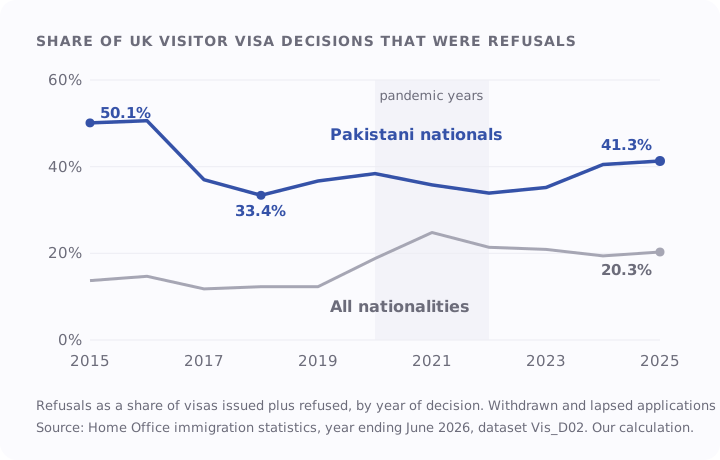
In 2025 the UK decided 156,359 visitor visa applications from Pakistani nationals. It issued 91,741 and refused 64,618. That is a refusal rate of 41.3 percent, or roughly two applications in five.
Across all nationalities the visitor refusal rate in 2025 was 20.3 percent. A Pakistani applicant is refused at twice the world rate.
The first half of 2026 is running slightly worse. Of 73,469 decisions from January to June, 31,064 were refusals, a rate of 42.3 percent. These quarters are provisional and will be revised, but the direction is not in doubt.
Year by year
| Year | Issued | Refused | Refusal rate |
|---|---|---|---|
| 2015 | 44,976 | 45,126 | 50.1% |
| 2016 | 41,091 | 42,066 | 50.6% |
| 2017 | 56,218 | 33,009 | 37.0% |
| 2018 | 66,534 | 33,412 | 33.4% |
| 2019 | 69,777 | 40,541 | 36.7% |
| 2020 | 20,814 | 12,989 | 38.4% |
| 2021 | 19,075 | 10,620 | 35.8% |
| 2022 | 79,763 | 40,923 | 33.9% |
| 2023 | 88,164 | 47,819 | 35.2% |
| 2024 | 89,346 | 60,856 | 40.5% |
| 2025 | 91,741 | 64,618 | 41.3% |
| 2026, January to June | 42,405 | 31,064 | 42.3% |
Visitor visas of all kinds for Pakistani nationals, by year of decision. The rate is refusals as a share of visas issued plus refused; withdrawn and lapsed applications are left out. Source: Home Office, Vis_D02, year ending June 2026.
Three things stand out.
The rate has been this high before. In 2015 and 2016 half of all Pakistani visitor applications were refused. It then fell for three years to a low of 33.4 percent in 2018 and stayed in the mid thirties through 2023.
It has risen for three years running. From 33.9 percent in 2022 to 35.2, then 40.5, then 41.3 percent. Refusals grew from 40,923 to 64,618 in three years, a rise of 58 percent, while issued visas grew by only 15 percent.
Demand is at a record. More Pakistanis applied for UK visitor visas in 2025 than in any year on record, and more were issued than in any year on record. The rising rate is not the UK issuing fewer visas. It is more applications, and a larger share of them failing.
How Pakistan compares
Among the twenty nationalities with the most UK visitor visa decisions in 2025, Pakistan had the fourth highest refusal rate.
| Nationality | Decisions in 2025 | Refusal rate |
|---|---|---|
| Bangladesh | 40,285 | 48.6% |
| Ghana | 46,641 | 43.6% |
| Iraq | 21,447 | 42.9% |
| Pakistan | 156,359 | 41.3% |
| Nigeria | 169,839 | 38.2% |
| Morocco | 34,181 | 34.6% |
| Sri Lanka | 31,726 | 27.3% |
| India | 677,234 | 18.0% |
| Turkey | 261,339 | 10.3% |
| China | 516,512 | 8.6% |
Source: Home Office, Vis_D02, year ending June 2026, our calculation.
The comparison with India is the one Pakistani applicants should sit with. Indian applicants are refused at 18 percent, less than half the Pakistani rate, and the gap is not explained by income. It is explained by what the Home Office's caseworkers find in the files, which the next section covers.
What the refusals cost
The Home Office fee for a standard six-month visitor visa was £115 until April 2025 and £127 after it, and it is not refunded when an application is refused. At those rates the 64,618 refusals of 2025 cost Pakistani applicants between £7.4 million and £8.2 million in fees alone, before the visa centre's charges, document preparation, translations and any agent's fee. ProPakistani, working from a compilation by Gallup Pakistan, put the 2025 figure at £9.17 million, and Dawn reported £5.3 million lost on refused UK applications in 2023.
The Schengen area refused Pakistani applicants at a similar rate. ProPakistani and Daily Qudrat report 40,199 Schengen refusals in 2025, about 46 percent of applications, and a combined 112,387 UK and Schengen refusals in the year, costing an estimated Rs 4.56 billion in non-refundable fees.
Why files from Pakistan fail
The dataset records outcomes, not reasons. But every refusal notice quotes the paragraph of the Immigration Rules the caseworker relied on, and in the refusal notices Pakistani applicants show us the paragraph is almost always the same one: paragraph V 4.2 of Appendix V, the genuine visitor requirement. The caseworker was not satisfied that the applicant would leave at the end of the visit, or that they could support themselves without working, or that the money shown was genuinely available to them.
That paragraph is decided on the file, and the files that fail share the same faults. A bank statement with a large deposit and no source. An employment letter that a verification call does not confirm. A form that leaves out a previous refusal the Home Office already has on record. A purpose of visit that the invitation letter contradicts. None of these is about how much money the applicant has. All of them are about whether the file is consistent and honest, and all of them are avoidable.
We have written about each of them in detail:
- The eight mistakes that get UK Standard Visitor applications refused, one section per fault the caseworkers find.
- The complete requirements checklist, built from the Home Office's own guide to supporting documents.
- How to write the cover letter, the one page in the file that explains everything else.
What the numbers mean for your application
A 41 percent refusal rate is not a coin toss that every applicant faces equally. It is the average of two very different groups: files that answer the genuine visitor test with consistent documents, which are mostly approved, and files with a gap or a contradiction, which are mostly refused. The rate tells you how many Pakistani applicants submit the second kind. It does not tell you which kind yours will be. That is decided before you press submit, by whether every figure, date and claim in your file agrees with every other.
Niklo exists to move files from the second group into the first. The application asks for the evidence the Home Office lists, the AI review reads every answer against every document and raises anything that disagrees, and a case reviewer reads the whole file before you print it and file it yourself. The refusal rate is the Home Office's number. Whether your file is consistent is yours.
Sources
- Home Office, Immigration system statistics, year ending June 2026, published 27 August 2026. Dataset "Entry clearance visa applications and outcomes, Vis_D02", from the immigration system statistics data tables. All figures in the two tables above are our calculation from this dataset: decisions by nationality, visa type group "Visitor", by calendar year of decision. Data from the first quarter of 2026 onwards are provisional.
- Home Office, How many people come to the UK each year?, year ending June 2026, for the total of 2.2 million visitor visas issued worldwide.
- UK Visas and Immigration, Visiting the UK: guide to supporting documents, updated 25 February 2026.
- Home Office, Immigration Rules Appendix V: Visitor, paragraph V 4.2, the genuine visitor requirement.
- Home Office, Immigration and nationality fees tables: the table dated 10 April 2024 lists the short visit visa at £115, and the tables from 1 May 2025 onwards at £127.
- ProPakistani, Pakistanis paid Rs 4.5 billion only to face one of the highest UK and Schengen visa rejections, 12 July 2026, citing a compilation by Gallup Pakistan and Macro Pakistani.
- Daily Qudrat, Over 112,000 UK and Schengen visa applications from Pakistan rejected in 2025.
- Dawn, UK, Schengen states make millions off rejected visas, 11 June 2024, reporting analysis by the Lago Collective for the year ending December 2023.
- European Commission, Schengen visa policy and statistics, which publishes the annual visa statistics by consulate that the Schengen figures above are drawn from.
Would you rather we prepared it?
Niklo fills the form from your answers, AI and a case reviewer check every field, and you get the finished application to print and file yourself.